

Introduction
Goyen pulse valves are widely used in industrial dust collection systems where compressed-air pulses are required to clean filter bags and cartridges.
A pulse valve operates by rapidly releasing compressed air into a blow tube. The resulting air pulse removes accumulated dust from the surface of the filter media and helps maintain stable airflow through the dust collector.
For maintenance engineers and industrial purchasing teams, selecting the correct Goyen pulse valve requires more than simply matching the valve connection size. Valve series, model, port size, diaphragm material, pilot configuration, operating pressure, and coil specifications should all be considered.
When a valve has been operating for an extended period, the diaphragm and other sealing components may eventually wear. In these situations, a compatible Goyen pulse valve repair kit can often restore the valve without requiring complete replacement.
This guide explains Goyen pulse valves, their common applications, model identification, diaphragm replacement, repair kits, troubleshooting, and replacement considerations.
What Is a Goyen Pulse Valve?
A Goyen pulse valve is a diaphragm-type pneumatic valve designed for pulse jet dust collection systems.

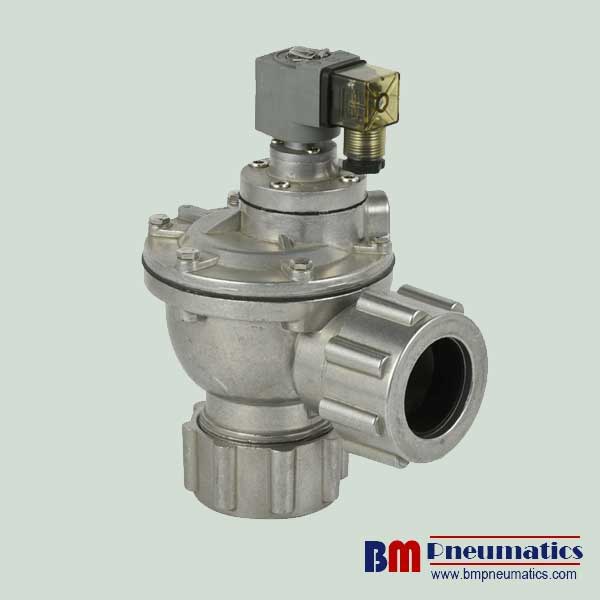
The valve is normally connected between a compressed-air manifold and the blow tube of a dust collector.
When the pulse controller activates the pilot solenoid, pressure in the control chamber changes. This causes the main diaphragm to open rapidly and release compressed air through the outlet.
The short-duration, high-volume air pulse travels through the blow tube and cleans the filter media.
After the pulse, the diaphragm returns to its closed position and the valve waits for the next cleaning signal.
This cycle may be repeated thousands of times during normal industrial operation.
Why Are Goyen Pulse Valves Used in Dust Collectors?
Dust collectors depend on effective filter cleaning to maintain stable airflow.
As dust accumulates on filter bags or cartridges, resistance increases. If the filters are not cleaned effectively, the system may experience:
- Increased differential pressure
- Reduced airflow
- Higher fan energy consumption
- Reduced filtration performance
- More frequent filter replacement
A properly functioning pulse valve provides the compressed-air pulse required to remove accumulated dust.
Because industrial dust collectors often operate continuously, pulse valve reliability is an important part of overall system performance.
Common Applications of Goyen Pulse Valves
Goyen pulse valves can be found in many industrial dust collection applications.
Cement and Building Materials
Dust collection systems are used throughout cement production, including:
- Raw material processing
- Grinding
- Conveying
- Clinker handling
- Cement packaging
Pulse valves provide repeated cleaning pulses to maintain filter performance.
Steel and Metallurgy
Steel plants generate dust from processes such as:
- Furnace operation
- Material handling
- Grinding
- Casting
- Welding
Pulse jet dust collectors use compressed-air cleaning to maintain filter efficiency.
Mining and Mineral Processing
Mining operations generate dust during:
- Crushing
- Screening
- Conveying
- Grinding
- Mineral separation
The abrasive nature of mining dust makes reliable filter cleaning particularly important.
Power Plants
Dust collection systems in power plants may be exposed to coal dust, ash, and other fine particles.
Pulse valves are used to maintain filter performance under continuous operating conditions.
Chemical Processing
Chemical plants may require pulse valves with diaphragm materials suitable for elevated temperatures, moisture, or chemical exposure.
Material compatibility should always be evaluated according to the actual application.
Woodworking
Woodworking facilities use pulse jet dust collectors to remove sawdust and fine particles from production areas.
Regular filter cleaning helps maintain airflow and reduce filter blockage.
Goyen Pulse Valve Series and Model Identification
Goyen pulse valves are available in different series and configurations for industrial dust collection applications.
Commonly encountered product families include the following types:
- CA series
- RCA series
- DD series
- T series
- Other application-specific configurations
The exact model should always be identified from the valve nameplate or product documentation.
A model number may contain information related to:
- Valve series
- Port size
- Connection type
- Valve configuration
- Pilot arrangement
Because similar-looking valves can have different internal components, buyers should avoid selecting a replacement based only on appearance.
How to Identify a Goyen Pulse Valve
Before purchasing a replacement valve or repair kit, record the information available on the existing valve.
Check the Model Number
The complete model number is the most useful identification information.
For example, a valve may be identified by a series designation followed by information relating to its size or configuration.
Always record the complete model rather than only the series name.
Check the Port Size
Measure or confirm the inlet and outlet connection dimensions.
A replacement valve must match the existing dust collector installation.
Check the Valve Configuration
Determine whether the existing valve is a:
- Right-angle configuration
- Straight-through configuration
- Other specialized design
Check the Coil
Record:
- Voltage
- Frequency
- Coil connection
- Electrical specifications
The replacement coil must be compatible with the pulse controller.
Goyen Pulse Valve Diaphragm
The diaphragm is one of the primary wear components inside a pulse valve.
During every cleaning cycle, the diaphragm moves rapidly to open and close the main airflow passage.
After repeated operation, the diaphragm may gradually deteriorate.
Common failure conditions include:
- Cracking
- Hardening
- Tearing
- Deformation
- Loss of elasticity
- Poor sealing
A damaged diaphragm can result in continuous compressed-air leakage or insufficient cleaning pulses.
Common Goyen Pulse Valve Diaphragm Materials
The correct diaphragm material depends on the operating environment.
NBR
NBR is commonly used for general industrial applications.
It provides good mechanical properties and is suitable for many standard dust collection systems.
EPDM
EPDM provides good resistance to:
- Moisture
- Weather exposure
- Ozone
It may be suitable for outdoor or humid environments where the application requirements allow it.
FKM
FKM is selected for applications requiring increased resistance to temperature or certain chemicals.
The exact material should be selected according to the operating conditions rather than simply choosing the most expensive option.
What Is a Goyen Pulse Valve Repair Kit?
A Goyen pulse valve repair kit contains replacement components intended to restore a compatible pulse valve.
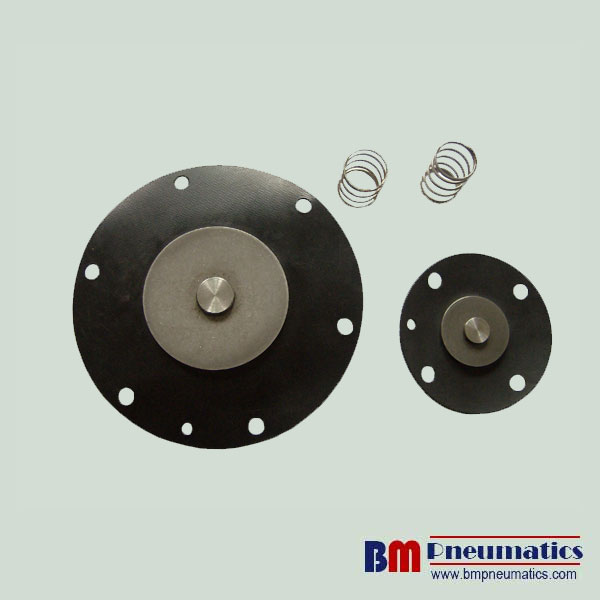
Depending on the valve model, a kit may contain:
- Main diaphragm
- Pilot diaphragm
- O-rings
- Springs
- Sealing components
- Other internal parts
The exact contents depend on the valve design.
Repair kits are particularly useful when the valve body remains in good condition but the internal wear components have deteriorated.
When Should You Replace a Goyen Pulse Valve Diaphragm?
Several symptoms may indicate that the diaphragm needs inspection or replacement.
Continuous Air Leakage
If the valve continues to leak compressed air between cleaning cycles, the diaphragm may no longer provide a proper seal.
Weak Cleaning Pulse
A damaged diaphragm may fail to open fully.
This can reduce the amount of compressed air reaching the blow tube.
Increased Compressed Air Consumption
Air leakage increases the demand on the compressed-air system.
Slow Valve Response
An aging or damaged diaphragm may respond more slowly than a new component.
Visible Damage
During inspection, replace the diaphragm if it shows:
- Cracks
- Tears
- Severe deformation
- Hardening
- Surface deterioration
Goyen Pulse Valve Troubleshooting
When a Goyen pulse valve does not operate correctly, troubleshooting should begin with the simplest possible causes.
Check the Compressed Air Supply
Confirm that:
- Air pressure is adequate
- Air supply is clean
- Moisture is controlled
- The manifold is not leaking
Poor compressed-air quality can shorten diaphragm and pilot component life.
Check the Electrical Signal
Verify:
- Controller output
- Wiring
- Coil voltage
- Electrical connections
If the solenoid does not receive the correct signal, the pulse valve cannot operate normally.
Check the Pilot Solenoid
A pilot problem can prevent the main diaphragm from opening.
Inspect the pilot assembly for contamination, damage, or abnormal operation.
Inspect the Diaphragm
If the air and electrical systems are working correctly, inspect the diaphragm and sealing components.
Check the Blow Tube
A pulse valve can operate normally while the dust collector still performs poorly if the blow tube is blocked, damaged, or incorrectly positioned.
How to Replace a Goyen Pulse Valve Diaphragm
A diaphragm replacement should be performed after isolating the valve from compressed air and electrical power.
Step 1: Shut Down the System
Close the compressed-air supply and release residual pressure.
Disconnect electrical power before removing the valve components.
Step 2: Remove the Valve Cover
Remove the retaining bolts and carefully separate the valve cover.
Pay attention to the original position of the diaphragm and spring.
Step 3: Remove the Old Diaphragm
Inspect the diaphragm after removal.
The condition of the failed diaphragm may provide useful information about the cause of the problem.
Step 4: Clean the Sealing Surfaces
Remove dirt or foreign material from the internal sealing surfaces.
Avoid damaging the valve body or sealing areas.
Step 5: Install the Replacement Diaphragm
Install the new diaphragm and associated components in the correct orientation.
Make sure the diaphragm is properly seated.
Step 6: Reassemble the Valve
Install the spring and cover, then tighten the fasteners evenly.
Step 7: Test the Valve
Restore compressed air and electrical power.
Check:
- Valve response
- Air leakage
- Pulse strength
- Closing performance
Goyen Pulse Valve Repair Kit vs Complete Valve Replacement
When a valve fails, maintenance teams often need to decide between replacing internal components and replacing the entire valve.
A Repair Kit May Be Suitable When
- Valve body is in good condition
- Diaphragm is worn
- Seals have deteriorated
- Pilot components remain functional
- Internal passages are not seriously damaged
The main advantage is lower maintenance cost.
A Complete Valve May Be Better When
- Valve body is cracked
- Severe corrosion is present
- Internal passages are damaged
- Multiple components have failed
- Repair is no longer economical
The decision should be based on the actual condition of the valve rather than simply its operating age.
How to Choose the Right Goyen Replacement Valve
Before purchasing a replacement, verify:
Valve Model
Match the complete model number whenever possible.
Port Size
Confirm the connection dimensions.
Valve Configuration
Make sure the replacement has the correct installation arrangement.
Coil Voltage
The coil must match the dust collector controller.
Working Pressure
Confirm that the replacement valve is suitable for the compressed-air pressure used by the system.
Diaphragm Material
Select the appropriate material according to:
- Temperature
- Humidity
- Chemical exposure
- Operating conditions
Installation Dimensions
Check the physical dimensions of the valve before ordering.
This is particularly important when replacing valves in an existing manifold.
How to Extend Goyen Pulse Valve Service Life
Several maintenance practices can help extend service life.
Use Clean and Dry Compressed Air
Water, oil, and particles can accelerate diaphragm wear.
Maintain the air treatment system regularly.
Avoid Excessive Pulse Frequency
Unnecessary valve cycling increases diaphragm wear.
Optimize the dust collector controller settings according to actual operating requirements.
Monitor Air Leakage
Continuous leakage should be investigated rather than ignored.
Keep Compatible Repair Kits Available
Maintaining commonly used diaphragms and repair kits can reduce emergency downtime.
Inspect Valves Periodically
Regular inspection allows worn components to be replaced before they cause larger system problems.
Frequently Asked Questions
What is a Goyen pulse valve used for?
A Goyen pulse valve is used in pulse jet dust collection systems to release compressed-air pulses for cleaning filter bags and cartridges.
What is a Goyen pulse valve repair kit?
It is a set of replacement components, typically including diaphragms and sealing parts, used to restore a compatible pulse valve.
Can I replace only the Goyen diaphragm?
Yes. If the valve body and other major components are still in good condition, replacing the diaphragm can restore normal operation.
Why is my Goyen pulse valve leaking?
Common causes include diaphragm damage, worn seals, contamination, incorrect assembly, or problems with the pilot system.
How do I identify the correct Goyen repair kit?
Start with the complete valve model number and then verify the diaphragm dimensions, valve series, and other relevant specifications.
How often should a Goyen pulse valve be maintained?
There is no universal replacement interval. Maintenance requirements depend on operating pressure, pulse frequency, compressed-air quality, temperature, dust characteristics, and other site conditions.
Can a Goyen pulse valve be replaced by another brand?
A compatible replacement may be possible, but the replacement should be evaluated against technical specifications such as dimensions, airflow characteristics, pressure range, coil voltage, and diaphragm design.
Conclusion
Goyen pulse valves are important components in industrial pulse jet dust collection systems, where reliable and rapid compressed-air cleaning is required.
For maintenance and procurement teams, correct identification is essential when purchasing replacement valves, diaphragms, or repair kits. The complete model number, valve size, configuration, coil specification, operating pressure, and diaphragm material should all be considered.
When only the internal wear components have deteriorated, a compatible Goyen pulse valve repair kit can often provide a more economical maintenance solution than replacing the complete valve.
With proper compressed-air treatment, regular inspection, suitable operating settings, and timely replacement of worn components, pulse valves can provide reliable performance and help maintain stable dust collector operation.