
The ASCO SCG353A047 pulse jet valve is a solenoid-operated diaphragm valve designed for compressed-air cleaning systems in industrial dust collectors. As part of the ASCO Series 353 range, it features an integral pilot design that delivers a rapid compressed-air pulse to clean filter bags and cartridges.
With a nominal pipe size of 1.5 inches, the SCG353A047 is suitable for dust collection systems that require a larger air passage than smaller 3/4-inch and 1-inch pulse valves. Its valve structure is designed to provide high airflow and fast opening and closing during repeated cleaning cycles.
For equipment manufacturers, maintenance teams, and industrial distributors, understanding the model’s connection size, flow characteristics, operating pressure, and repair kit reference is important when selecting replacement components.
1. ASCO SCG353A047 Pulse Jet Valve Overview
The SCG353A047 belongs to the ASCO Series 353 integral-pilot pulse valve family. It uses a solenoid-controlled pilot mechanism and a diaphragm assembly to control the release of compressed air.
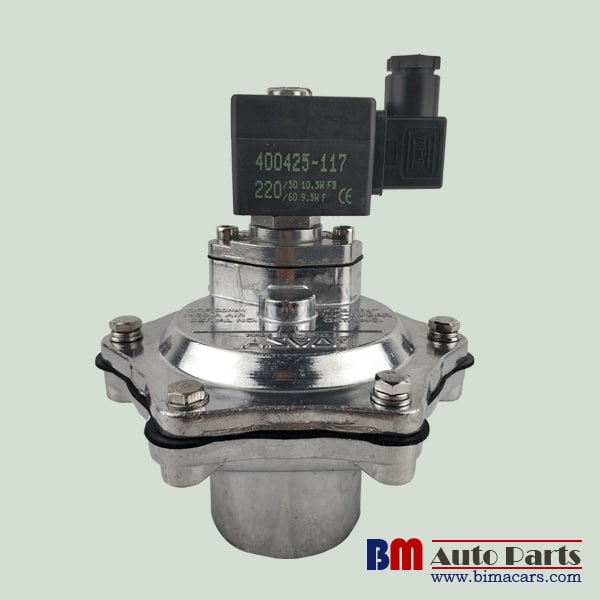
During a cleaning cycle, the electrical control system energizes the solenoid. The pilot mechanism then activates the diaphragm, allowing compressed air to flow through the valve and into the blow tube. This creates a short, high-energy pulse that helps remove accumulated dust from the filter media.
When the electrical signal ends, the valve returns to its closed position and prepares for the next cleaning cycle.
Key product characteristics include:
- Manufacturer: ASCO
- Product series: 353
- Model number: SCG353A047
- Valve type: Integral-pilot diaphragm pulse valve
- Nominal pipe size: 1.5 inches
- Orifice size: 50 mm
- Valve structure: Two-way, normally closed
- Body material: Aluminium
- Core and spring materials: Stainless steel
- Seal material: NBR
- Diaphragm options: CR or FPM, depending on the specified configuration
- Operating medium: Compressed air
- Differential pressure range: 0.35–8.5 bar
These specifications are based on the referenced ASCO Series 353 catalogue. The complete valve configuration should be checked before ordering, particularly when diaphragm material or electrical options are important.
2. Technical Specifications of SCG353A047
The following table summarizes the principal technical data for the SCG353A047.
| Parameter | Specification |
|---|---|
| Manufacturer | ASCO |
| Series | 353 |
| Model | SCG353A047 |
| Valve type | Integral-pilot diaphragm pulse valve |
| Valve function | 2-way, normally closed |
| Pipe size | 1.5 inches |
| Orifice size | 50 mm |
| Flow coefficient (Kv) | 44 m³/h |
| Flow coefficient (reference) | 733 l/min |
| Differential pressure | 0.35–8.5 bar |
| Body material | Aluminium |
| Core and plugnut | Stainless steel |
| Core spring | Stainless steel |
| Sealing and disc | NBR |
| Diaphragm options | CR or FPM |
| Ambient temperature range | -20°C to +85°C |
| Reference weight | Approximately 1.4 kg, including coil and connector |
Understanding the 1.5-inch connection
The 1.5-inch nominal pipe size is an important identification feature of the SCG353A047. It should not be confused with the smaller SCG353A043 and SCG353A044 models.
When replacing an existing valve, check the pipe connection standard and installation dimensions. A nominally similar connection does not automatically guarantee mechanical compatibility.
Flow capacity and pressure requirements
The catalogue lists a flow coefficient (Kv) of 44 m³/h and an orifice size of 50 mm for this model. These values help describe the valve’s flow characteristics and are useful when evaluating its suitability for a dust collector cleaning system.
The specified differential pressure range is 0.35–8.5 bar. The compressed-air supply should provide sufficient pressure during the cleaning cycle to allow the diaphragm valve to operate correctly.
Actual cleaning performance also depends on the blow tube design, air reservoir capacity, piping arrangement, pulse duration, and filter configuration.
Electrical options
The referenced Series 353 catalogue lists standard electrical options including:
- 24 V DC
- 24 V AC, 50 Hz
- 115 V AC, 50 Hz
- 230 V AC, 50 Hz
Other voltage and frequency options may be available on request, depending on the solenoid configuration.
Before purchasing a replacement, check the existing coil label and electrical connection. The valve model alone is not sufficient to determine the required coil voltage.
3. Applications of the SCG353A047 Pulse Jet Valve
The SCG353A047 is designed for industrial dust collector cleaning systems where reliable compressed-air pulses are required.
Baghouse dust collectors
In baghouse filtration systems, dust gradually accumulates on the surface of filter bags. The pulse cleaning system releases compressed air through blow tubes to remove this dust.
The SCG353A047 can be used in compatible systems designed around its 1.5-inch connection and operating requirements. Its flow characteristics make it suitable for applications where a larger pulse valve is specified by the dust collector manufacturer.
Cartridge dust collectors
Cartridge filters are widely used in industrial processes involving fine dust and particulate matter. Their filtration performance depends partly on effective periodic cleaning.
A properly selected pulse valve helps deliver the compressed-air burst required to remove dust from the filter surface. The valve size, air pressure, and pulse timing should be matched to the cartridge collector design.
Cement and building materials production
Cement plants, concrete production facilities, and other building materials operations generate dust during material handling, conveying, mixing, and processing.
Dust collectors installed in these areas require regular filter cleaning. The SCG353A047 may be selected for compatible pulse cleaning systems where its connection size and technical characteristics meet the equipment requirements.
Metallurgy and industrial manufacturing
Metal processing and other manufacturing operations often use centralized dust collection systems to control airborne particles.
In these environments, pulse valves are important components of the filtration system. Correct valve selection and regular maintenance help maintain consistent cleaning performance.
4. Installation and Maintenance Considerations
Proper installation and maintenance are important for maintaining reliable operation and extending the service life of the SCG353A047.
Check the connection before installation
Confirm that the replacement valve has the correct 1.5-inch pipe connection and thread standard. Check the installation dimensions and available clearance before fitting the valve.
The compressed-air piping should be clean and free from excessive moisture, oil, and solid contamination. Follow the manufacturer’s installation instructions and ensure that the pipework does not place unnecessary mechanical stress on the valve body.
Maintain a suitable compressed-air supply
Insufficient pressure or unstable air supply can affect diaphragm movement and reduce pulse cleaning effectiveness.
Check the air reservoir, pressure regulator, piping, and upstream filtration if the valve operates slowly or fails to produce a consistent cleaning pulse.
Inspect the diaphragm assembly
The diaphragm is one of the main working components of a pulse jet valve. Repeated operating cycles, contaminated compressed air, and unsuitable operating conditions can contribute to diaphragm wear.
Common symptoms of diaphragm-related problems include:
- Continuous air leakage through the valve
- Weak or inconsistent cleaning pulses
- Delayed valve opening or closing
- Failure to operate during the cleaning sequence
If these symptoms occur, isolate the compressed-air supply and inspect the diaphragm assembly according to the manufacturer’s maintenance procedure.
Check the solenoid and control system
Not every pulse valve failure is caused by the diaphragm. Electrical problems can also prevent the valve from operating.
Inspect the coil, wiring, connector, and pulse controller output. Confirm that the applied voltage and frequency match the installed coil.
Always disconnect electrical power and fully depressurize the system before performing maintenance.
5. C113827 Diaphragm Repair Kit for SCG353A047
For maintenance and repair applications, C113827 is listed in the referenced ASCO Series 353 catalogue as the spare parts kit for the SCG353A047.
The repair kit is intended to support maintenance of the diaphragm assembly rather than requiring replacement of the complete valve whenever a compatible diaphragm component becomes worn.
Before ordering C113827, verify the following:
- Valve model: Confirm that the installed valve is SCG353A047.
- Diaphragm material: Check whether the original assembly uses CR or FPM.
- Kit configuration: Confirm the supplied components and their compatibility with the valve revision.
- Operating conditions: Ensure that the selected diaphragm material is suitable for the compressed air and temperature conditions.
- Maintenance requirements: Follow the appropriate installation instructions when replacing internal components.
A repair kit should not be selected based only on the valve’s nominal pipe size. Different Series 353 models may use different diaphragm assemblies and spare parts references.
For replacement enquiries, providing the complete valve model and existing diaphragm reference helps suppliers identify the correct repair kit.
6. SCG353A047 vs. Other ASCO Series 353 Models
The ASCO Series 353 range includes several pulse valve sizes and configurations. The following comparison highlights the differences between selected integral-pilot models.
| Model | Nominal pipe size | Main identification |
|---|---|---|
| SCG353A043 | 3/4 inch | Smaller threaded pulse valve |
| SCG353A044 | 1 inch | Threaded pulse valve |
| SCG353A047 | 1.5 inches | Larger threaded pulse valve |
| SCG353A050 | 2 inches | Higher nominal connection size |
| SCG353A051 | 2.5 inches | Larger nominal connection size |
The most important distinction is the nominal connection size. These models should not be treated as interchangeable simply because they belong to the same product series.
When selecting a replacement, confirm the complete model number, connection dimensions, electrical configuration, and spare parts reference.
7. Frequently Asked Questions
What is the pipe size of the ASCO SCG353A047?
The SCG353A047 has a nominal pipe size of 1.5 inches. Check the actual thread standard and connection details before installing a replacement.
What is the orifice size of the SCG353A047?
The referenced ASCO catalogue lists an orifice size of 50 mm.
What is the operating pressure range?
The specified differential pressure range is 0.35–8.5 bar. The compressed-air supply must meet the requirements of the installed valve configuration.
Which diaphragm repair kit is used for the SCG353A047?
C113827 is listed as the corresponding spare parts kit for the SCG353A047 in the referenced catalogue. Confirm the diaphragm material and valve revision before ordering.
What diaphragm materials are available?
The referenced catalogue identifies CR (chloroprene) and FPM (fluoroelastomer) diaphragm options. Material selection should be based on the exact valve configuration and operating conditions.
What causes an SCG353A047 valve to leak compressed air?
Possible causes include diaphragm damage, contamination, sealing problems, or unsuitable operating pressure. The solenoid and pilot mechanism should also be inspected if the valve does not operate correctly.
Conclusion
The ASCO SCG353A047 pulse jet valve is a 1.5-inch integral-pilot diaphragm valve designed for industrial dust collector cleaning systems. Its key specifications include a 50 mm orifice, a Kv flow coefficient of 44 m³/h, and a differential pressure range of 0.35–8.5 bar.
For maintenance applications, C113827 is the listed spare parts kit for this model. However, the diaphragm material and complete valve configuration should be verified before ordering replacement components.
BMP Pneumatics supplies ASCO-type pulse jet valves and diaphragm repair kits for industrial dust collection systems. Contact our team with your valve model and technical requirements to identify a suitable replacement solution.