
The ASCO SCG353A051 pulse jet valve is a solenoid-operated diaphragm valve designed for compressed-air cleaning systems in industrial dust collectors. It belongs to the ASCO Series 353 range, a product family developed for high-flow pulse cleaning applications that require fast valve response and reliable operation.
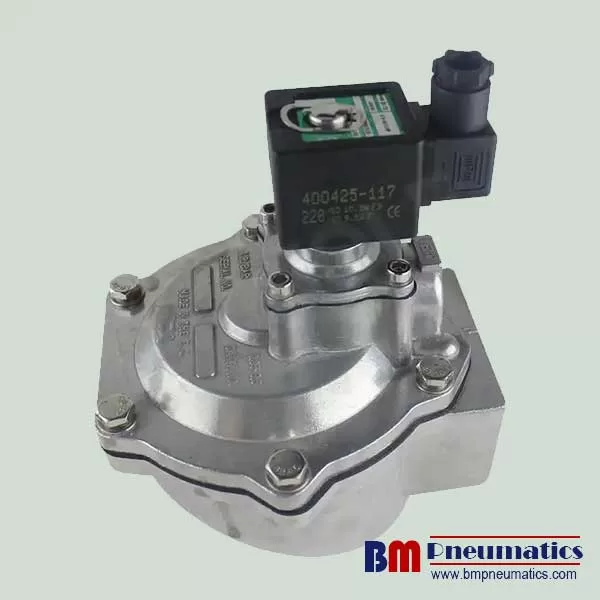
With a nominal 2.5-inch threaded connection, the SCG353A051 is designed for dust collection systems that require substantial compressed-air delivery during filter cleaning cycles. Its 66 mm orifice and Kv flow coefficient of 92 m³/h make it a large-capacity option within the Series 353 product family.
The valve is used as part of a complete pulse cleaning arrangement, where compressed air is released through blow tubes to remove accumulated dust from filter bags or cartridges. Correct selection requires checking the connection size, operating pressure, electrical configuration, and spare parts reference.
1. ASCO SCG353A051 Pulse Jet Valve Overview
The SCG353A051 is an integral-pilot diaphragm pulse valve in the ASCO Series 353 range. It uses a solenoid-controlled pilot mechanism to operate the main diaphragm and release compressed air into the dust collector cleaning system.
During a cleaning cycle, the control system energizes the solenoid coil. The pilot mechanism changes the pressure balance across the diaphragm, allowing the main valve to open and release a short compressed-air pulse. The pulse travels through the blow tube and helps remove dust accumulated on the filter media.
When the electrical signal ends, the valve returns to its normally closed position and prepares for the next cleaning cycle.
Key product characteristics include:
- Manufacturer: ASCO
- Product series: 353
- Model: SCG353A051
- Product type: Integral-pilot diaphragm pulse valve
- Valve function: Two-way, normally closed
- Nominal pipe size: 2.5 inches
- Orifice size: 66 mm
- Flow coefficient (Kv): 92 m³/h
- Operating medium: Compressed air
- Body material: Aluminium
- Core tube, core, and plugnut: Stainless steel
- Core spring: Stainless steel
- Sealing material: NBR
- Diaphragm options: CR or FPM, depending on configuration
The exact materials and electrical configuration should be confirmed against the complete valve identification and applicable product documentation.
2. Technical Specifications of SCG353A051
The following table summarizes the main technical data published in the ASCO Series 353 catalogue.
| Parameter | Specification |
|---|---|
| Manufacturer | ASCO |
| Series | 353 |
| Model | SCG353A051 |
| Valve type | Integral-pilot diaphragm pulse valve |
| Valve function | 2-way, normally closed |
| Nominal pipe size | 2.5 inches |
| Orifice size | 66 mm |
| Flow coefficient (Kv) | 92 m³/h |
| Reference flow value | 1,540 l/min |
| Differential pressure range | 0.35–8.5 bar |
| Operating medium | Air |
| Body material | Aluminium |
| Core tube | Stainless steel |
| Core and plugnut | Stainless steel |
| Core spring | Stainless steel |
| Sealing material | NBR |
| Diaphragm options | CR or FPM |
| Standard ambient temperature range | -20°C to +85°C |
| Reference weight | Approximately 2.60 kg, including coil and connector |
These values are based on the referenced Series 353 catalogue. The complete valve configuration should be checked before using them as final engineering or purchasing specifications.
2.5-inch threaded connection
The 2.5-inch nominal pipe size is one of the most important identification features of the SCG353A051. It distinguishes this model from the 2-inch SCG353A050, even though both models have a 66 mm orifice.
The referenced catalogue identifies the threaded connection as G thread according to ISO 228/1. Other connection arrangements may be available within the wider Series 353 family, so check the actual valve version before ordering.
When replacing an existing valve, compare the connection standard, installation dimensions, and piping arrangement. Nominal pipe size alone is not sufficient to establish interchangeability.
Flow coefficient and compressed-air capacity
The SCG353A051 has a catalogue Kv value of 92 m³/h, with a reference flow value of approximately 1,540 l/min.
This flow coefficient is useful when evaluating the valve’s flow capacity in a compressed-air cleaning system. However, it should not be interpreted as the actual air consumption of every cleaning cycle.
Actual pulse performance depends on several factors, including:
- Compressed-air reservoir capacity
- Available supply pressure
- Blow tube diameter and arrangement
- Piping length and pressure losses
- Pulse duration and cleaning sequence
- Number of valves operating simultaneously
For this reason, valve selection should be coordinated with the dust collector’s overall cleaning system design.
Operating pressure and temperature
The referenced ASCO catalogue specifies a differential pressure range of 0.35–8.5 bar for the SCG353A051.
The standard ambient temperature range is -20°C to +85°C. The catalogue also identifies different diaphragm material options with different temperature limits:
- CR (chloroprene): -20°C to +85°C
- FPM (fluoroelastomer): -20°C to +120°C
These diaphragm temperature ranges should not be confused with the ambient temperature rating of the complete valve. Confirm the selected material and operating conditions before installation.
Electrical configuration
The Series 353 catalogue lists the following standard supply options:
- DC: 24 V
- AC: 24 V, 115 V, and 230 V at 50 Hz
Other voltages and 60 Hz versions may be available on request.
The electrical supply must match the installed solenoid coil. Check the coil label, connector, and control system output before replacing the valve or coil. Do not assume that every SCG353A051 has the same voltage configuration.
3. Industrial Applications of the SCG353A051
The SCG353A051 is designed for pulse cleaning duties in industrial dust collection systems. Its large nominal connection and flow characteristics make it suitable for compatible installations that require substantial compressed-air pulses.
Baghouse dust collectors
Baghouse systems use filter bags to separate dust particles from industrial exhaust air. During operation, dust accumulates on the filter surfaces and increases airflow resistance.
The pulse cleaning system periodically releases compressed air through blow tubes to dislodge the accumulated dust. The SCG353A051 can be used in compatible baghouse installations designed around its 2.5-inch connection and operating requirements.
Cartridge dust collectors
Cartridge collectors use pleated filter elements to capture fine dust and particulate matter. Effective pulse cleaning helps remove accumulated material from the filter surface and maintain stable filtration performance.
The valve must be matched to the collector’s air reservoir, blow tube arrangement, and cleaning sequence. A larger valve does not automatically guarantee better cleaning if the rest of the system is not properly designed.
Cement and building materials production
Cement plants and building materials facilities generate dust during crushing, conveying, mixing, storage, and packaging operations.
Dust collectors installed in these areas require reliable cleaning systems to maintain filtration performance. The SCG353A051 may be considered for compatible installations where its connection size and technical characteristics meet the equipment requirements.
Steel and metal processing
Steel production and metal processing involve material handling, cutting, grinding, and other operations that generate airborne particles.
Pulse jet valves are important components of the dust collection equipment used in these environments. Correct valve selection, suitable compressed-air quality, and regular maintenance help support continuous filtration operation.
Chemical and power generation industries
Chemical production facilities and power plants also use industrial dust collectors to manage particulate emissions from different processes.
For these applications, engineers should evaluate diaphragm material compatibility, temperature conditions, compressed-air quality, and electrical protection requirements before selecting the valve.
4. Installation and Maintenance Considerations
Correct installation and routine maintenance help maintain reliable operation and reduce unnecessary downtime in dust collection systems.
Check the connection and installation dimensions
Before installing the SCG353A051, confirm the 2.5-inch threaded connection and G-thread standard where applicable.
Compare the replacement valve’s dimensions with the existing installation. Check the available space around the valve body and solenoid assembly, and ensure that the piping does not place excessive mechanical stress on the connection.
The ASCO Series 353 catalogue states that the valves can be mounted in any position without affecting operation for the specified construction types. Always confirm that the particular valve version meets this condition and follow its installation instructions.
Maintain compressed-air quality
Contaminated compressed air can affect the pilot mechanism, diaphragm, and sealing surfaces. Moisture, oil, and solid particles may contribute to inconsistent operation or premature wear.
Check the air preparation equipment, upstream filtration, and reservoir condition as part of routine maintenance.
Verify the operating pressure
The compressed-air supply must provide sufficient differential pressure for the valve to operate correctly.
If the valve produces weak pulses or fails to open consistently, inspect the air reservoir, pressure regulator, piping, and pressure losses before replacing internal components.
Inspect the diaphragm assembly
The diaphragm is a critical working component of the pulse valve. Repeated operating cycles and unsuitable working conditions may eventually cause wear or damage.
Common symptoms that may indicate a diaphragm problem include:
- Continuous compressed-air leakage
- Weak or inconsistent cleaning pulses
- Delayed opening or closing
- Failure to operate during the cleaning sequence
Before opening the valve, disconnect electrical power and fully depressurize the compressed-air system. Follow the manufacturer’s maintenance procedure when inspecting or replacing the diaphragm assembly.
Check the solenoid and control circuit
A valve that does not respond to the cleaning signal may have an electrical fault rather than a diaphragm problem.
Inspect the solenoid coil, connector, wiring, and pulse controller output. Confirm that the supply voltage and frequency match the installed coil.
Replacing the diaphragm will not resolve a fault caused by an incorrect electrical supply or damaged solenoid.
5. C113685 and C113686 Repair Kits for SCG353A051
The ASCO Series 353 catalogue identifies two spare parts kit references for the SCG353A051:

- C113685: Listed for the AC version.
- C113686: Listed for the DC version.
This distinction is important when selecting a replacement diaphragm repair kit. The correct reference should be matched to the valve’s electrical configuration and the applicable spare parts documentation.
Before ordering, verify the following:
- Valve model: Confirm that the installed valve is SCG353A051.
- Electrical version: Identify whether the valve uses an AC or DC coil.
- Repair kit reference: Check whether C113685 or C113686 applies to the specific version.
- Diaphragm material: Confirm whether CR or FPM is required for the operating conditions.
- Kit contents: Check that the supplied components match the original valve assembly.
Do not select a repair kit based only on the 2.5-inch connection size. The electrical configuration and internal assembly must also be considered.
When requesting a quotation, providing the valve nameplate information and a photograph of the existing assembly can help the supplier confirm the appropriate kit.
6. SCG353A051 vs. SCG353A050
The SCG353A050 and SCG353A051 are both large-size ASCO Series 353 pulse valves. However, their nominal pipe sizes and flow coefficients are different.
| Parameter | SCG353A050 | SCG353A051 |
|---|---|---|
| Nominal pipe size | 2 inches | 2.5 inches |
| Orifice size | 66 mm | 66 mm |
| Flow coefficient (Kv) | 77 m³/h | 92 m³/h |
| Reference flow value | 1,290 l/min | 1,540 l/min |
| Differential pressure range | 0.35–8.5 bar | 0.35–8.5 bar |
| Repair kit references | C113685 / C113686 | C113685 / C113686 |
Although the two models share several technical characteristics and repair kit references, their connection sizes are different.
The SCG353A051 has a higher catalogue flow coefficient and a larger nominal pipe connection. It should not be treated as a direct replacement for the SCG353A050 without checking the piping and dust collector design.
7. Frequently Asked Questions
What is the connection size of the ASCO SCG353A051?
The SCG353A051 has a nominal pipe size of 2.5 inches. The referenced catalogue identifies a G-thread connection according to ISO 228/1.
What is the orifice size of the SCG353A051?
The ASCO Series 353 catalogue lists a 66 mm orifice size.
What is the flow coefficient of the SCG353A051?
The catalogue lists a Kv flow coefficient of 92 m³/h, with a reference flow value of approximately 1,540 l/min.
What is the operating pressure range?
The specified differential pressure range is 0.35–8.5 bar. Confirm the operating conditions against the complete valve configuration.
What is the difference between C113685 and C113686?
The referenced ASCO Series 353 spare parts table lists C113685 for the AC version and C113686 for the DC version of the SCG353A051. Check the valve’s electrical configuration before ordering.
Which diaphragm materials are available?
The Series 353 catalogue identifies CR (chloroprene) and FPM (fluoroelastomer) diaphragm options. Their temperature ranges differ, so material selection should be based on the actual operating environment.
Can the SCG353A051 replace the SCG353A050?
Not as a direct mechanical replacement without modification. The SCG353A051 has a 2.5-inch nominal connection, while the SCG353A050 has a 2-inch connection. Check the piping arrangement and system design before considering a substitution.
Conclusion
The ASCO SCG353A051 pulse jet valve is a 2.5-inch integral-pilot diaphragm valve designed for compressed-air cleaning in industrial dust collection systems. Its main catalogue specifications include a 66 mm orifice, a Kv flow coefficient of 92 m³/h, and a differential pressure range of 0.35–8.5 bar.
For maintenance work, the ASCO Series 353 catalogue lists C113685 for the AC version and C113686 for the DC version. Confirm the valve’s electrical configuration and diaphragm material before ordering replacement components.
BMP Pneumatics supplies pulse jet valves and diaphragm repair solutions for industrial dust collection applications. Contact our team with your valve model and technical requirements to help identify a suitable replacement or repair kit.