
Introduction
A right angle pulse valve is one of the most widely used valve designs in industrial pulse jet dust collection systems. It is specifically engineered to deliver a rapid burst of compressed air for cleaning filter bags and cartridges in applications where reliable performance, fast response, and efficient airflow are essential.
Because of its simple structure, excellent flow characteristics, and easy maintenance, right angle pulse valves have become the standard choice for many industries, including cement manufacturing, steel production, mining, power generation, chemical processing, and woodworking.
Although the basic function of a pulse valve is similar across different designs, the right angle configuration provides several unique advantages in installation flexibility, airflow control, and maintenance accessibility.
This guide explains what a right angle pulse valve is, how it works, its main components, advantages, applications, specifications, and how to select the right model for your dust collection system.
What Is a Right Angle Pulse Valve?
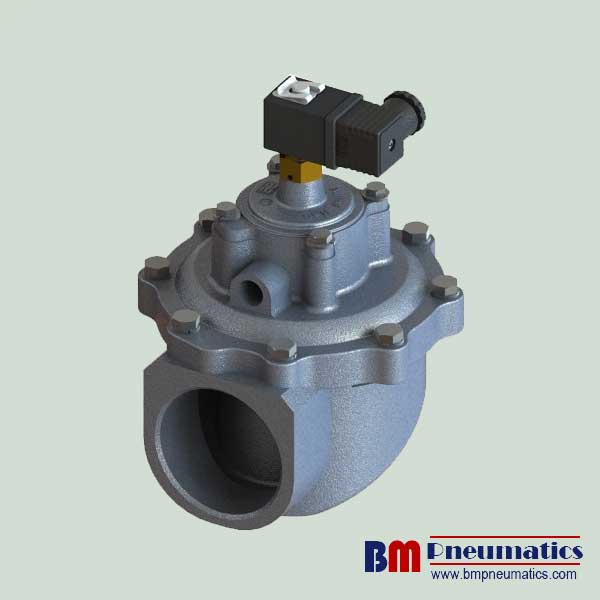
A right angle pulse valve is a diaphragm-type pneumatic valve where the inlet and outlet ports are positioned at a 90-degree angle.
The valve receives compressed air from the air manifold through the inlet port and releases it through the outlet port into the blow tube when activated.
The 90-degree flow path allows the valve to be installed conveniently on the side of a dust collector air header, making it especially suitable for baghouse and cartridge filtration systems.
Unlike ordinary solenoid valves, right angle pulse valves are designed specifically for high-speed pulse cleaning applications.
Their main function is not continuous airflow control, but rather:
- Rapid compressed air discharge
- High-energy cleaning pulses
- Repeated operation under demanding conditions
- Efficient removal of dust from filter media
How Does a Right Angle Pulse Valve Work?
The operating principle of a right angle pulse valve is based on diaphragm pressure control.
During normal operation, compressed air enters the valve and fills the upper chamber above the diaphragm.
The pressure on both sides of the diaphragm remains balanced, keeping the valve closed.
When the pulse controller sends an electrical signal, the pilot solenoid valve opens and releases pressure from the upper chamber.
The pressure difference causes the diaphragm to lift rapidly.
Compressed air stored in the manifold is then released through the outlet port into the blow tube.
The high-speed airflow creates a powerful cleaning pulse that removes dust from filter bags or cartridges.
After the pulse ends, the pilot valve closes, pressure is restored above the diaphragm, and the valve returns to its closed position.
The entire process usually takes less than a few hundred milliseconds.
Main Components of a Right Angle Pulse Valve
A typical right angle pulse valve consists of several key components.
Valve Body
The valve body provides the main structure and contains the internal air passages.
Most industrial models use aluminum alloy because it offers:
- Lightweight construction
- Good corrosion resistance
- Excellent machining accuracy
- Suitable strength for industrial pressure applications
For harsh environments, stainless steel versions may be available.
Diaphragm Assembly
The diaphragm is the most critical wear component.
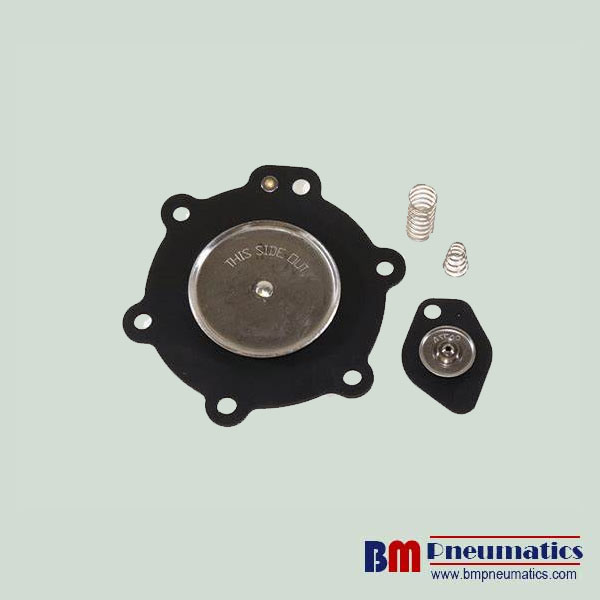
It controls the opening and closing of the main airflow passage.
Common diaphragm materials include:
NBR Diaphragm
Suitable for:
- General industrial applications
- Normal temperature environments
- Standard dust collectors
EPDM Diaphragm
Suitable for:
- Humid environments
- Outdoor installations
- Water vapor exposure
FKM Diaphragm
Suitable for:
- High-temperature applications
- Chemical environments
A high-quality diaphragm improves:
- Response speed
- Sealing performance
- Service life
Pilot Solenoid Valve
The pilot solenoid controls the diaphragm movement.
It receives signals from the pulse controller and initiates the opening sequence.
Common coil voltages include:
- 24V DC
- 24V AC
- 110V AC
- 220V AC
Spring and Sealing Components
The spring helps return the diaphragm to the closed position.
Seals and O-rings prevent compressed air leakage and maintain stable operation.
Advantages of Right Angle Pulse Valves
1. Excellent Airflow Performance
The 90-degree design provides an efficient airflow path suitable for pulse cleaning applications.
The valve can release a large volume of compressed air quickly, creating an effective cleaning pulse.
2. Easy Installation
The compact side-mounted design makes installation simple, especially on existing dust collector systems.
Maintenance personnel can easily access the valve without removing large sections of equipment.
3. Reliable Operation
Right angle pulse valves are designed for millions of operating cycles.
Their robust diaphragm structure provides reliable performance under continuous industrial operation.
4. Wide Application Range
Because of their versatility, right angle pulse valves are used in many industries and dust collection systems.
5. Easy Maintenance and Repair
When diaphragm wear occurs, the repair process is relatively simple.
In many cases, replacing the diaphragm and seals with a compatible pulse valve repair kit can restore the valve to normal operation.
Common Applications of Right Angle Pulse Valves
Cement Industry
Cement production generates large quantities of dust during:
- Crushing
- Grinding
- Material transfer
- Packaging
Right angle pulse valves are widely used in cement dust collectors because they provide reliable cleaning performance in continuous operation.
Steel Industry
Steel plants use dust collection systems for:
- Furnace emissions
- Welding fumes
- Grinding dust
- Metal particles
Reliable pulse cleaning is essential for maintaining filtration efficiency.
Mining Industry
Mining environments contain abrasive dust requiring strong cleaning performance.
Right angle pulse valves are commonly installed in:
- Crushing plants
- Screening equipment
- Mineral processing systems
Woodworking Industry
Wood dust collectors rely on pulse valves to maintain airflow and prevent filter blockage.
Applications include:
- Furniture production
- Sawing
- Sanding
- Panel manufacturing
Chemical and Pharmaceutical Industry
These industries require careful selection of diaphragm materials due to chemical compatibility and cleanliness requirements.
Right Angle Pulse Valve Specifications
Typical specifications include:
| Parameter | Typical Range |
|---|---|
| Valve Type | Diaphragm pulse valve |
| Connection Type | Threaded |
| Port Size | 3/4″ to 3″ |
| Working Pressure | 0.3–0.8 MPa |
| Temperature Range | Depends on diaphragm material |
| Coil Voltage | 24V / 110V / 220V |
| Medium | Clean compressed air |
Actual specifications vary depending on manufacturer and application requirements.
Right Angle Pulse Valve vs Other Pulse Valve Types
Right Angle Pulse Valve
Best for:
- General industrial dust collectors
- Easy maintenance applications
- Standard baghouse systems
Submerged Pulse Valve
Best for:
- Large filtration systems
- High airflow applications
- Space-limited installations
Straight Through Pulse Valve
Best for:
- Systems requiring minimal pressure loss
- High-volume cleaning applications
Selecting the correct design depends on dust collector configuration and operating requirements.
How to Choose the Right Right Angle Pulse Valve
Before purchasing, consider:
- Valve size
- Connection dimensions
- Working pressure
- Coil voltage
- Diaphragm material
- Dust characteristics
- Temperature conditions
- Replacement parts availability
It is also important to confirm compatibility with existing dust collector equipment.
Maintenance Tips
To maximize service life:
- Use clean and dry compressed air.
- Check regularly for air leakage.
- Inspect diaphragms periodically.
- Replace worn repair kits promptly.
- Avoid excessive pulse frequency.
- Maintain proper air pressure.
Proper maintenance reduces downtime and improves dust collector efficiency.
FAQ
What is a right angle pulse valve used for?
A right angle pulse valve is mainly used for cleaning filter bags and cartridges in industrial pulse jet dust collectors.
How long does a right angle pulse valve last?
Service life depends on operating conditions, compressed air quality, and maintenance. High-quality valves can operate for millions of cycles.
Can I replace only the diaphragm?
Yes. If the valve body is still in good condition, replacing the diaphragm with a compatible repair kit is usually more economical than replacing the entire valve.
What pressure does a right angle pulse valve require?
Most industrial models operate between 0.3 and 0.8 MPa.
Conclusion
Right angle pulse valves are one of the most reliable and widely adopted solutions for industrial dust collector cleaning systems. Their fast response, efficient airflow design, easy installation, and simple maintenance make them suitable for a wide range of applications.
Choosing the correct valve size, diaphragm material, and operating configuration ensures better cleaning performance, lower compressed air consumption, and longer equipment life.
For companies operating dust collection systems, investing in reliable right angle pulse valves and compatible repair kits is an effective way to improve system efficiency and reduce long-term maintenance costs.